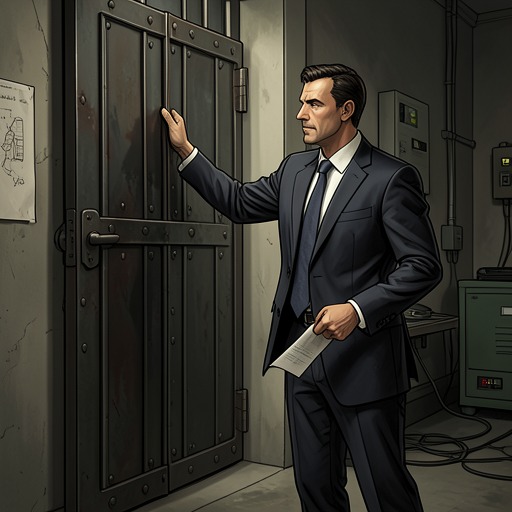
Andy searches Jacob’s room before the warrant is executed
Defending JacobBefore police could execute a search warrant, Andy Barber entered his home and searched Jacob Barber’s room for incriminating material. The episode turns Andy’s fear of a potentially unreliable justice system into action: he insists he is protecting an innocent son, yet his attempt to control what investigators might find places that protection in direct conflict with the law.
The warrant and Andy’s urgency
The search begins after Andy has been taken to his office and realizes that the authorities may be keeping him away from home while a warrant team prepares to search it. He does not panic; instead, he describes a calm urgency. Jacob’s homicide charge feels to him like a grenade that will destroy the family, with only the details of that destruction still undecided. His immediate goal is to get home before the police can search.
Four Newton police cruisers are already outside the Barber family home in Newton, watching the house while they wait for the warrant. Andy drives around the block and approaches from the commuter-train stop beside his property. He climbs the eight-foot fence between the platform and his backyard, pushes through the arbor vitae, and runs across the lawn. A neighbor gardening nearby waves; Andy returns the greeting by reflex as he rushes past. The ordinary courtesy makes the covert entry feel all the more jarring: a familiar domestic landscape has become the edge of a police operation.
Searching Jacob’s room
Inside, Andy calls quietly for Jacob, intending to prepare him for what is coming, but nobody is home. He runs upstairs and searches Jacob’s room, opening drawers and the closet and tossing aside laundry. He is looking for anything remotely incriminating that he can get rid of before the police arrive. The act is not a considered investigation; it is an urgent attempt to make an unknown threat manageable when Andy does not know what evidence the district attorney has or what has made the authorities so eager to charge his son.
The search yields only the ordinary clutter of a teenager’s room: dirty laundry, sneakers shaped by Jacob’s large feet, schoolbooks, video-game magazines, and charging cables for his electronics. Andy finds nothing that alarms him. The mundane objects offer no answer to the question driving his fear—what missing piece of evidence has prompted the charge?—and his uncertainty remains intact even as he has crossed a legal line to look for it.
The laptop left behind
Andy considers hiding Jacob’s laptop because its hard drive might contain damaging material. But removing it could itself look suspicious, especially given Jacob’s online presence; leaving it, on the other hand, risks allowing police to discover whatever it holds. Andy ultimately leaves the computer, deciding there is no time to weigh the choice further and supposing that Jacob may already have scrubbed the drive after being publicly accused on Facebook. The laptop becomes the search’s unresolved object: a possible source of evidence, a possible target of suspicion, and a decision Andy cannot safely settle.
The doorbell rings while Andy is still turning over the room. The warrant has arrived: Paul Duffy is at the door to hand it to him, apologizing as he does so. Andy’s attempt to act before the search is reduced to a brief, unsuccessful interval. He has found nothing to remove and has left the most uncertain object in place; the official search is now beginning.
A father’s distrust of the system
Andy’s search is driven not by a newly discovered clue but by what he sees as the danger of entrusting Jacob’s fate to fallible human judgment. He argues that memories fail, eyewitness identifications are unreliable, and police officers can misjudge and misremember. In his view, courts are not exempt from the errors that affect people generally, and innocent defendants can be convicted. He presents his actions as an effort to secure a just result for a son he says he believes is innocent.
That defense does not erase what he has done. Andy knows the search can be understood as destruction of evidence or obstruction of justice; his narration directly anticipates those charges even as it contests the premise that trust in the system is safer. The scene’s tension rests on that contradiction. Andy’s protective purpose is inseparable from an attempt to interfere with the investigation, while the absence of anything troubling in Jacob’s room offers neither proof of innocence nor an answer to the prosecution’s case. The search ends not with certainty, but with the warrant at the door and Andy still unable to know what the authorities believe they have found.